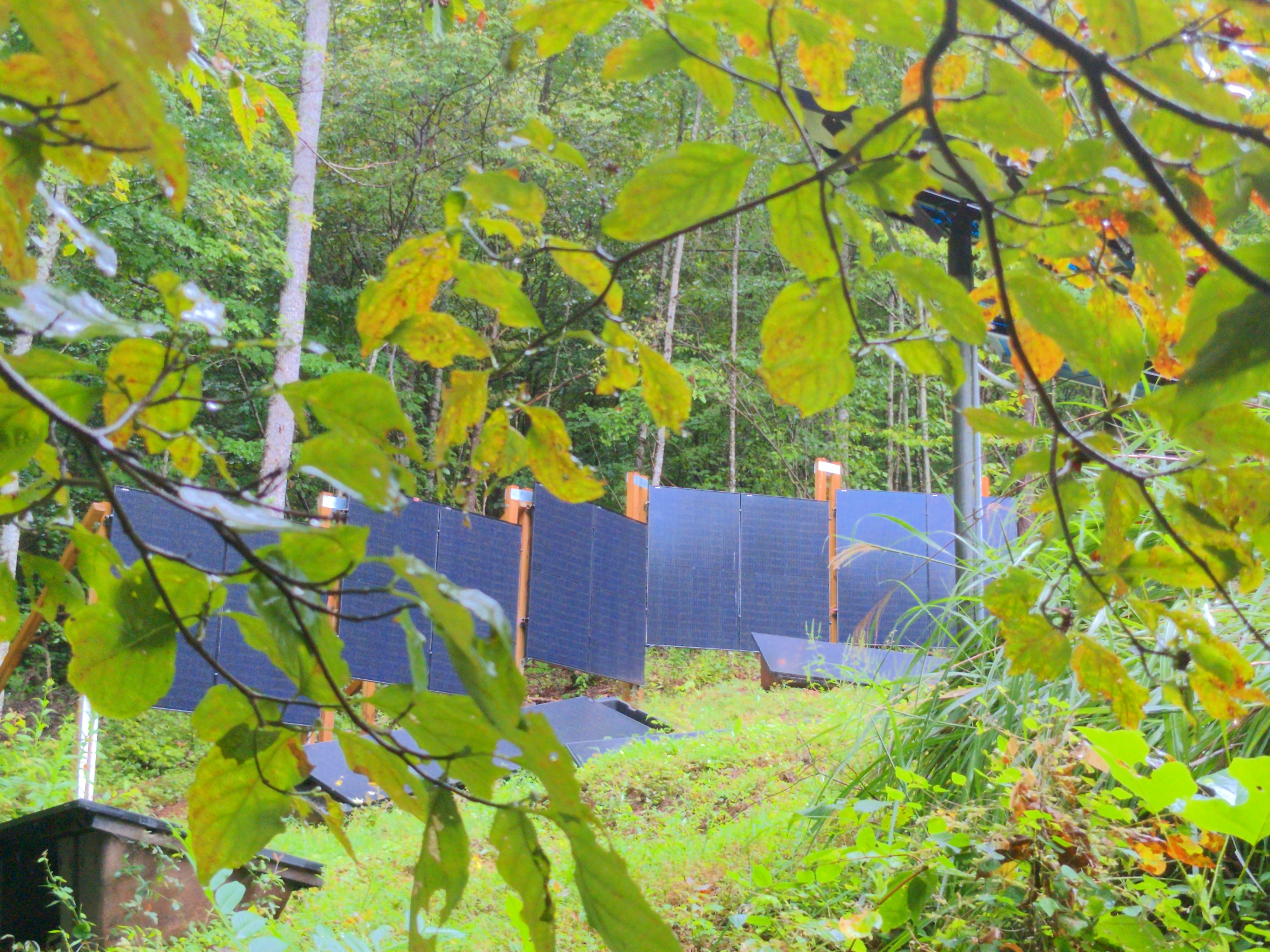
My house has 13 kw of solar panels, split between 1 kw on the roof a 4kw solar fence, and 8kw of ground mounted solar panels in two solar fields.
With solar panels pointing south, west, east (a few, a hill is in the way), and many angles in between, several arrays are always getting peak sun. And the vertical panels on the solar fence ensures there's a good amount of power even with snow. I like to think that the arrays are aiming at December.
 |
The arrays feed into six MPPT charge controllers, each a Tracer4215BN, and each capable of producing 1 kw. So the maximum total power is 6kw. The system is overpaneled by a factor of two to ensure that there is plenty of power even on cloudy days, and indeed even on mosty rainy days it produces enough power to charge my car.
(Why did I pick the little old Tracer4215BN in 2024? Because I had one for 7 years previously and it was rock solid. And it's silent, no fan. And it has minimal idle power draw. Also I have 6x redundancy and for cheap.)
Since batteries are the part of a PV system that wears out and has to be replaced, I want to minimize the number I use as much as possible. I use 4 Battleborn lithium batteries, which were installed in 2020 and have not degraded in any appreciable way yet.
But six kilowatts of power would could charge that small battery bank at faster than 1/2 C. To avoid charging it too fast, my home automation will turn off some of the charge controllers if too much power is being fed into the battery. That's a last resort, usually the excess power is dumped into my EV and hot water heater.
I have two inverters, a 3kw inverter for major loads and a 1.5kw inverter for around the house loads. I picked Samlex which seems to have been a good choice for a robust and reliable inverter, though pricy. Lighting, fans, and most small electronics are on direct DC power.
Total cost of the PV system:
$3535 batteries
$3097 pallet of solar panels
$1017 solar charge controllers
$2960 wire
$1788 inverters
$1100 solar fence
$3000 ground mounts and ballast
$2079 other hardware
-$4817 tax rebates
$13759 TOTAL
That's on top of the original 1kw solar install, which cost $2500 in 2017.
There's also an old array of 4 64 watt solar panels, though it's over 25 years old and produces less than 128 watts now. (It was used for pumping water until recently and still could, but is not currently used.)